DIA Does Not Move Like SPY Or QQQ, It Is Weighted By Price Not Size, And Trading It Like Another Cap-Weighted Index Fund Misses The One Mechanic That Actually Drives It
When you see the eight setups built around how DIA actually behaves between the sessions where nothing is happening, you will stop reading it like another cap-weighted index fund and start trading the one mechanic that makes it genuinely different: the Dow is weighted by each component's dollar price, not its market capitalization.
You will know why a single high-dollar-price component moving a couple of percent can swing DIA harder than a much larger company moving further, why the Dow's heavier tilt toward industrials, financials, and healthcare makes it react to manufacturing and jobs data differently than QQQ's tech-heavy basket, and how DIA's thinner volume relative to SPY shows up in its own opening spread.
Most range-day losses in DIA come from applying a cap-weighted read to a price-weighted index.
You will get opening range fades, VWAP mean reversion, a single-component price-weight distortion fade, a cyclical-data reaction range, a quarterly Dow reconstitution fade, and a thin-liquidity opening-spread fade.
You will see all eight setups in full, entry to exit, before you pay for a single one of them, one dollar unlocked at a time.
DIA is not SPY with thirty stocks instead of five hundred.
It is weighted by a different rule entirely, and the setup below trades that rule.
Introducing The DIA Range Setups Pack
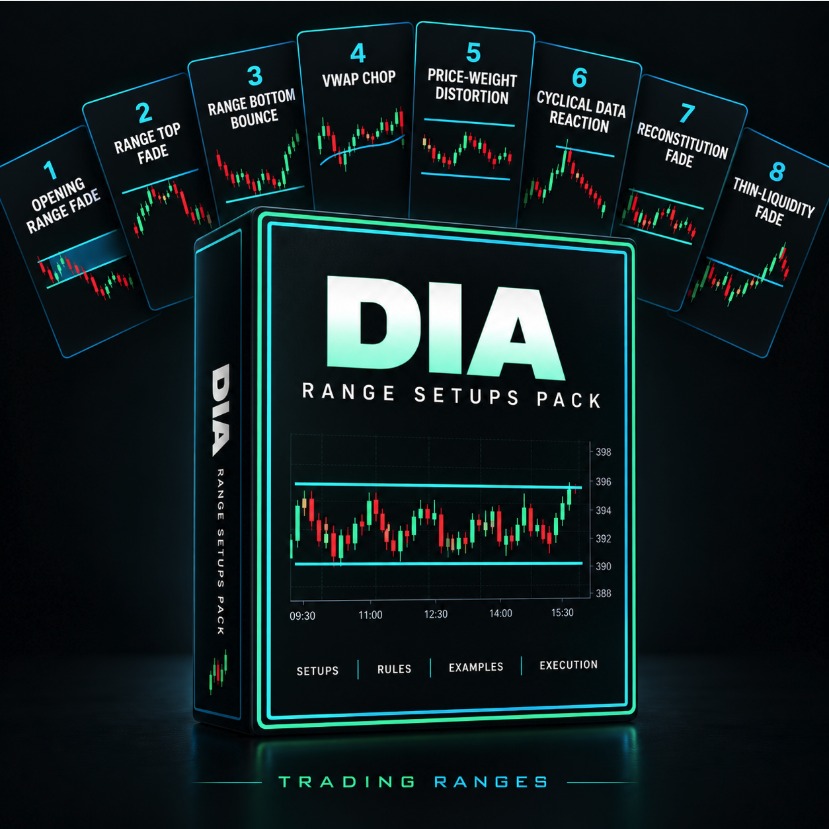
A Trading Ranges Setup Pack
The DIA Range Setups Pack
Eight ways to trade DIA when it is stuck between two levels, built around the Dow's price-weighted structure, its heavier industrial and financial tilt, and the thinner liquidity that shapes its own range differently from SPY or QQQ.
- Setups8, each priced individually at $1
- FormatInteractive preview on this page, plus a printable PDF cheat sheet after checkout
- AccessInstant, right after checkout, yours to keep
- Built forDIA specifically, 5-minute chart, using the Dow's own price-weighted mechanic and its own cyclical sector tilt
- AuthorTradingRanges.com
$1 per setup, 8 setups, $8 total. Every setup is priced and shown to you before you pay for any of it.
Try It First
Preview Every Setup In This Pack
Click through all 8 setups below. Each card is the entry trigger, the confirmation, and the invalidation point, the same detail you get after checkout. The bar fills as you go, one dollar unlocked per setup.
What's Inside
All 8 Setups
- 01Opening Range Fade (No Breakout). Once DIA's opening minutes fail to produce a clean breakout, fade both edges of that range, accounting for the choppier price discovery its thinner opening liquidity tends to produce.5-min chart, first 15-30 min
- 02Range Top Fade. Short at the top of a level DIA has already rejected twice, so you are betting on sellers who already showed up, not a level that might hold this time.5-min chart
- 03Range Bottom Bounce. Buy at the bottom of a level DIA has already held twice, the mirror of the range top fade, so you are never guessing which side of the range to trust.5-min chart
- 04VWAP Mean-Reversion Chop. Buy dips back toward VWAP once DIA has spent the session oscillating around it, the same chop-day read that works on any liquid index product once a genuine trend is absent.5-min chart
- 05Single-Component Price-Weight Distortion Fade. When a DIA range break traces back to one high-dollar-price component moving on its own, fade the break once that stock's own move stalls, since the Dow's price-weighted structure means one stock's percentage move can swing the index further than its actual size in the economy would suggest.5-min chart, on an outsized move in a high-dollar-price Dow component
- 06Cyclical-Data Reaction Range. On a manufacturing, jobs, or industrial-production release, trade a confirmed break of DIA's pre-release range in the data's own direction, since the Dow's heavier industrial and financial tilt makes it react to this category of data more directly than QQQ's tech-heavy basket does.5-min chart, on ISM manufacturing, jobs, or industrial-production data
- 07Quarterly Dow Reconstitution Fade. On the session a Dow component swap takes effect, fade a level break that comes on unusually heavy volume relative to how far price actually moves, since that mismatch often means mechanical index-fund flow rebuilding around the new component list, not a genuine directional decision.5-min chart, the session a Dow component change takes effect
- 08Thin-Liquidity Opening-Spread Fade. In DIA's first several minutes, fade an early spike that comes on light volume, since DIA's lower relative liquidity compared to SPY means its opening spread can produce a print that looks like a breakout but is actually just a wide bid-ask gap resolving itself.5-min chart, first 5-10 min
RANGES
★
Certificate of Guarantee
60-Day, No-Questions-Asked
If The DIA Range Setups Pack doesn't earn its place in your process, email us any time within 60 days of purchase for a full refund. No form to fill out. No reason required.

Backed personally by Jason Parker, founder of Trading Ranges. He built every setup in this pack himself, covered by the same guarantee above.
Instant Access
$8One-time payment. No subscription.
8 setups × $1 each = $8
Get Instant Access8 SETUPS · INTERACTIVE PREVIEW + PDF CHEAT SHEET · DELIVERED IMMEDIATELY AFTER CHECKOUT · 60-DAY GUARANTEE
A Few Notes On Trading DIA's Ranges
DIA tracks the Dow Jones Industrial Average, and the Dow is built on a mechanic no other index ETF in this shop shares. SPY and QQQ are both market-cap-weighted, meaning a company's influence on the index is proportional to its total market value. The Dow is price-weighted, meaning a component's influence is proportional only to its share price, regardless of the company's actual size. A stock trading at five hundred dollars a share moving two percent moves the index more in point terms than a stock trading at fifty dollars a share moving ten percent, even if the fifty-dollar company is the larger business by market cap.
The Dow's thirty components also carry a heavier tilt toward industrials, financials, and healthcare than QQQ's tech-heavy basket or even SPY's broader mix, which means DIA tends to react more directly to manufacturing data, jobs reports, and interest-rate-sensitive financial-sector news than to the AI and tech headlines that move QQQ hardest.
With only thirty components and meaningfully lower daily volume than SPY, DIA's own liquidity profile shows up most clearly at the open, where spreads can run wider and the first several minutes of trading can be choppier before genuine price discovery settles in.
Common Questions
Why is this priced at $1 per setup?
Every setup in The DIA Range Setups Pack is priced individually and added up. This pack has 8 setups, so it is $8 total, no more and no less. The interactive preview above shows every setup before you pay, so nothing is padded in to round out a bundle.
Do these setups work on SPY or QQQ too, or only DIA?
They are built around DIA's own behavior specifically, the Dow's price-weighted structure, its cyclical sector tilt, and its own thinner liquidity. Some of the underlying ideas, like VWAP mean reversion or a range top fade, generalize to other index ETFs, but the specific triggers here, especially the price-weight distortion setup, are unique to how the Dow itself is built.
What timeframe is this pack for?
Every setup in this pack is built for the 5-minute chart, the timeframe most day traders use to plan and enter DIA intraday trades.
What do I actually get after I pay?
Instant access to a printable PDF cheat sheet with the entry trigger, confirmation, and invalidation point for all 8 setups in this pack, the same detail shown in the preview deck above, formatted for a second screen or the desk next to your monitor.
Is there a guarantee?
Yes. The same 60-day, no-questions-asked guarantee as everything else in the shop. Email any time within 60 days of purchase for a full refund.