Low-Float Momentum Names Do Not Range Like A Mega-Cap With A Bigger Number, They Range Around How Few Shares Actually Exist To Trade
When you see the nine setups built around how a stock with a few million tradable shares actually ranges differently from a mega-cap with billions, you will stop applying a large-cap playbook to a name that can double, halt, and reverse before a mega-cap chart finishes printing its opening range.
You will know, before you are in the trade, how to read a volatility halt resumption, when cumulative volume has actually rotated the entire tradable float, and which breakouts are backed by genuine buying pressure against a name where a handful of sellers can end a move.
Most range-day losses on low-float names come from trading them like a large-cap stock that just happens to be moving faster.
You will get a gap-and-go opening range break, a VWAP reclaim continuation, a halt-resumption range built around a mechanic that only exists on this instrument class, a float-rotation range expansion setup, a parabolic exhaustion reversal, and a dilution-headline range break tied to the single catalyst most unique to thin-float names.
You will see all nine setups in full, entry to exit, before you pay for a single one of them, one dollar unlocked at a time.
A low-float stock is not a small mega-cap.
It is a different market structure entirely.
Introducing The Low-Float Momentum Range Setups Pack
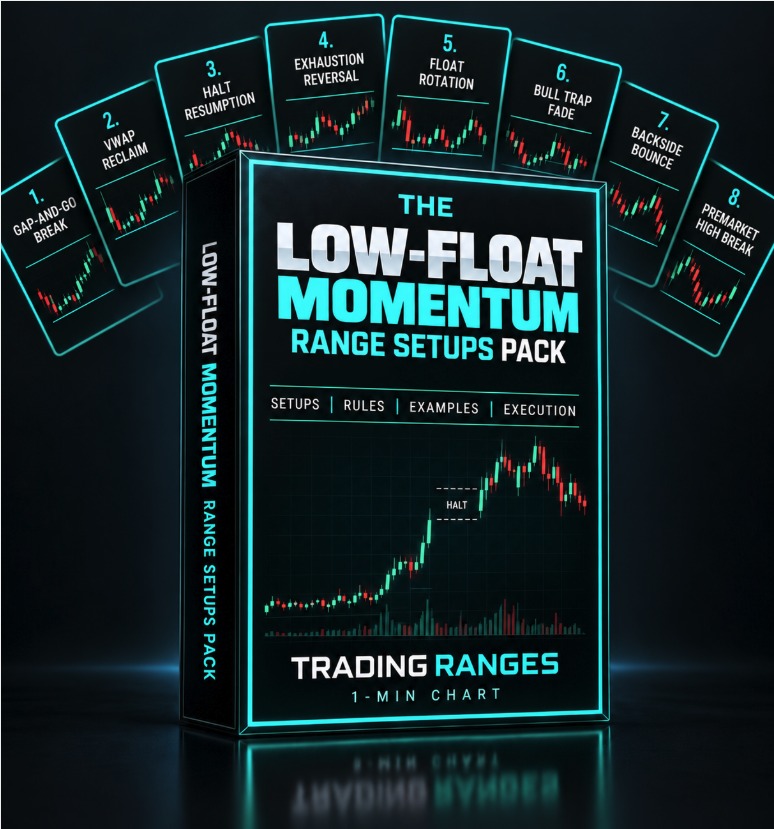
A Trading Ranges Setup Pack
The Low-Float Momentum Range Setups Pack
Nine ways to trade the 1-minute ranges of thin-float momentum stocks, built around halts, float rotation, and premarket structure no large-cap chart in this shop ever has to deal with.
- Setups9, each priced individually at $1
- FormatInteractive preview on this page, plus a printable PDF cheat sheet after checkout
- AccessInstant, right after checkout, yours to keep
- Built forLow-float momentum stocks specifically, 1-minute chart, the fastest timeframe in the shop for the fastest-moving instrument class in it
- AuthorTradingRanges.com
$1 per setup, 9 setups, $9 total. Every setup is priced and shown to you before you pay for any of it.
Try It First
Preview Every Setup In This Pack
Click through all 9 setups below. Each card is the entry trigger, the confirmation, and the invalidation point, the same detail you get after checkout. The bar fills as you go, one dollar unlocked per setup.
What's Inside
All 9 Setups
- 01Gap-and-Go Opening Range Break. Break the opening 1-minute range in the direction of a confirmed gap once volume clearly exceeds the prior session's comparable opening pace.1-min chart, first 1-5 min
- 02VWAP Reclaim Continuation. Buy the first pullback that holds and reclaims VWAP with rising volume, the standard continuation entry after a low-float name's initial push.1-min chart, after the first pullback
- 03Halt Resumption Range. Buy a break of the pre-halt high once the resumption print holds at or above the pre-halt price, a setup that only exists on an instrument class where volatility halts actually happen.1-min chart, immediately after a volatility halt lifts
- 04Parabolic Exhaustion Reversal. Fade the first red 1-minute candle on declining volume after an extended vertical run, since a low-float name that has run out of new buyers to chase it tends to top fast rather than grind sideways first.1-min chart, after an extended vertical run
- 05Float Rotation Range Expansion. Once cumulative volume rotates the entire tradable float, trade the next breakout with more conviction, since a name genuinely reset its shareholder base and range expansion tends to follow.1-min chart, once cumulative volume approaches the known float
- 06Failed Breakout Trap (Thin-Float Bull Trap). Fade a breakout that reverses back inside the prior range within a few candles, since a thin float means a handful of large sellers can trap an entire crowd of breakout buyers at once.1-min chart
- 07Backside Range Bounce. Buy a confirmed support bounce during the backside grind rather than chasing new highs, since the trade on day two or three is a range trade, not a momentum trade.1-min chart, day two or three after the initial spike
- 08Premarket High Break Confirmation. Buy a confirmed break of the premarket high at the open, with volume exceeding what originally set that level, since a low-float name's premarket high is a meaningfully predictive level in a way a mega-cap's rarely is.1-min chart, at the market open
- 09Dilution Headline Range Break. Break the session's range to the downside immediately on a confirmed dilution headline, a catalyst category unique to this instrument class since it directly changes the float the range was built around.1-min chart, on a share-offering press release
RANGES
★
Certificate of Guarantee
60-Day, No-Questions-Asked
If The Low-Float Momentum Range Setups Pack doesn't earn its place in your process, email us any time within 60 days of purchase for a full refund. No form to fill out. No reason required.

Backed personally by Jason Parker, founder of Trading Ranges. He built every setup in this pack himself, covered by the same guarantee above.
Instant Access
$9One-time payment. No subscription.
9 setups × $1 each = $9
Get Instant Access9 SETUPS · INTERACTIVE PREVIEW + PDF CHEAT SHEET · DELIVERED IMMEDIATELY AFTER CHECKOUT · 60-DAY GUARANTEE
A Few Notes On Trading Low-Float Momentum Ranges
This pack is built for stocks with a small tradable share count, commonly a few million shares or fewer, trading on a catalyst, a news headline, an earnings surprise, a sector rotation, that pulls in enough volume relative to that tiny float to produce outsized intraday moves. It is not one ticker. It is a recurring market structure that shows up across dozens of different small-cap and micro-cap names every trading week, which is exactly why the setups below are written around the structure itself, the float size, the halt mechanics, the volume-to-float ratio, rather than any single company's chart.
The habit that separates a trader who makes money on low-float ranges from one who gets run over by them: tracking how much of the tradable float has actually changed hands today before trusting any breakout, and treating a volatility halt as a structural event with its own resumption mechanics, not just a pause button. A large-cap trader can mostly ignore both of those questions. On a low-float name, they are the entire game.
None of this is built for a large-cap, mega-cap, or index product. VWAP, opening ranges, and support and resistance levels behave the same way structurally, but the float-rotation and halt-resumption setups in this pack have no equivalent anywhere else in this shop, because no other instrument here has a share count small enough for them to matter.
Common Questions
Why is this priced at $1 per setup?
Every setup in The Low-Float Momentum Range Setups Pack is priced individually and added up. This pack has 9 setups, so it is $9 total, no more and no less. The interactive preview above shows every setup before you pay, so nothing is padded in to round out a bundle.
This pack is not built around one ticker like the others. How does that work?
Low-float momentum is a recurring market structure, not a single company. A different small-cap name fits this pattern on a different day depending on what is moving, so the setups below are built around the structure itself, tiny tradable float, volatility halts, thin premarket liquidity, rather than any one ticker's specific history. The mechanics apply to whichever low-float name is actively moving on a given session.
What timeframe is this pack for?
Every setup in this pack is built for the 1-minute chart, the fastest timeframe in the shop and the one low-float momentum names typically require given how quickly they move.
What do I actually get after I pay?
Instant access to a printable PDF cheat sheet with the entry trigger, confirmation, and invalidation point for all 9 setups in this pack, the same detail shown in the preview deck above, formatted for a second screen or the desk next to your monitor.
Is there a guarantee?
Yes. The same 60-day, no-questions-asked guarantee as everything else in the shop. Email any time within 60 days of purchase for a full refund.