MSFT Does Not Range Like TSLA Or NVDA, And Trading It Like They Do Is How You Sit Through A Chop Day Waiting For A Move That Was Never Coming
When you see the nine setups built around how MSFT actually behaves between the sessions where nothing is happening, you will stop waiting for the wide, fast breaks TSLA and NVDA throw off and start trading the tighter, more orderly range MSFT actually gives you.
You will know how to size a MSFT range against its own tighter volatility instead of a habit built on a more volatile name, how to read the one Azure growth number that moves the stock more than headline earnings, and when the passive index flow around quarterly expiration is distorting a level rather than confirming it.
Most range-day losses in MSFT come from applying a volatility standard built on a different stock.
You will get opening range fades, VWAP mean reversion sized to MSFT's own tighter range, an Azure guidance-gap continuation built around how orderly its earnings reactions actually are, a quarterly index-flow fade, and a pre-macro compression tuned to a mega-cap name that moves markets instead of just following them.
You will see all nine setups in full, entry to exit, before you pay for a single one of them, one dollar unlocked at a time.
A quiet day in MSFT is not a broken setup.
It is a different range with its own rules.
Introducing The MSFT Range Setups Pack
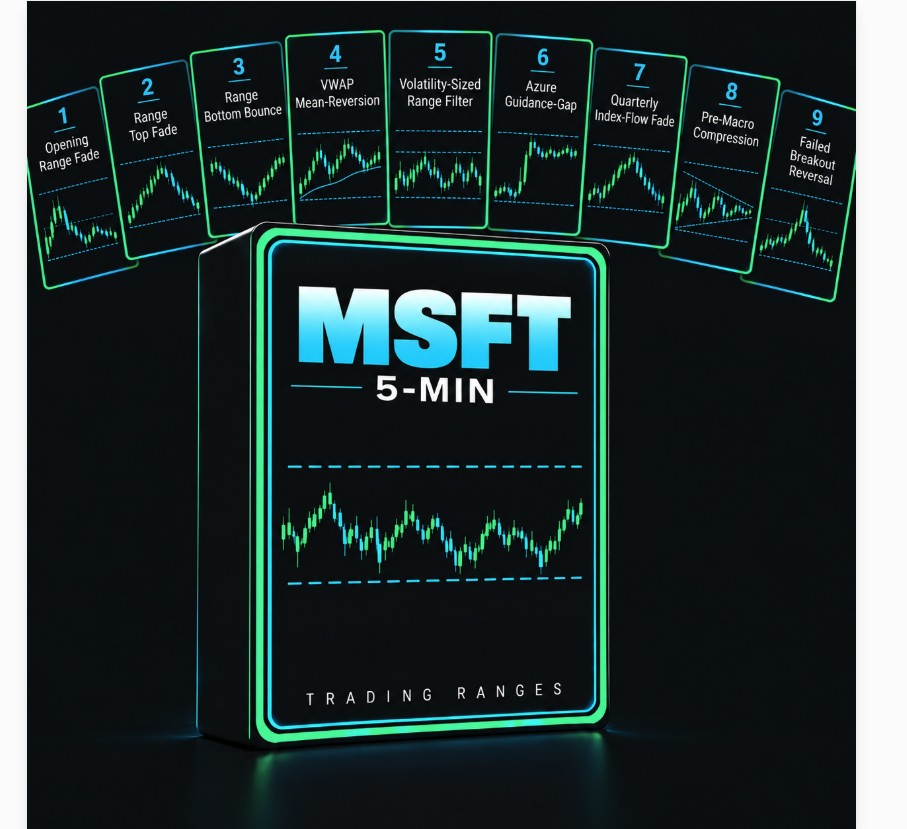
A Trading Ranges Setup Pack
The MSFT Range Setups Pack
Nine ways to trade MSFT when it is stuck between two levels, built around its own tighter volatility, its Azure growth number, and the passive index flow that shows up hardest into quarterly expiration.
- Setups9, each priced individually at $1
- FormatInteractive preview on this page, plus a printable PDF cheat sheet after checkout
- AccessInstant, right after checkout, yours to keep
- Built forMSFT specifically, 5-minute chart, using its own tighter volatility and its own quarterly index-flow patterns
- AuthorTradingRanges.com
$1 per setup, 9 setups, $9 total. Every setup is priced and shown to you before you pay for any of it.
Try It First
Preview Every Setup In This Pack
Click through all 9 setups below. Each card is the entry trigger, the confirmation, and the invalidation point, the same detail you get after checkout. The bar fills as you go, one dollar unlocked per setup.
What's Inside
All 9 Setups
- 01Opening Range Fade (No Breakout). Once MSFT's opening minutes fail to produce a clean breakout, fade both edges of that range instead of waiting for a move its own tighter volatility rarely delivers.5-min chart, first 15-30 min
- 02Range Top Fade. Short at the top of a level MSFT has already rejected twice, so you are betting on sellers who already showed up, not a level that might hold this time.5-min chart
- 03Range Bottom Bounce. Buy at the bottom of a level MSFT has already held twice, the mirror of the range top fade, so you are never guessing which side of the range to trust.5-min chart
- 04VWAP Mean-Reversion Chop. Buy dips back toward VWAP once MSFT has spent the session oscillating around it inside a range that is actually tight for this stock, not just tight in absolute terms.5-min chart
- 05Volatility-Sized Range Filter. Before trading any level, check the session's own range against MSFT's trailing average range instead of a habit borrowed from a louder stock, since a tight range in MSFT can still be a completely normal day for this particular name.5-min chart, checked against MSFT's own recent range
- 06Azure Guidance-Gap Continuation. Once MSFT's earnings gap lines up with the market's read on the Azure growth number and holds through the first half hour, trade with the gap instead of assuming it will fade like a more volatile stock's earnings reaction often does.5-min chart, the session after MSFT reports
- 07Quarterly Index-Flow Fade. During quarterly expiration week, fade a level break in MSFT that comes on unusually heavy volume relative to how far price actually moves, since that mismatch often means index and hedging flow, not a genuine directional decision.5-min chart, quarterly options expiration week
- 08Pre-Macro Compression Fade. Trade the shrinking oscillations inside MSFT's range in the session or two before a major macro release, since a mega-cap this large often compresses ahead of market-wide catalysts even without its own company-specific news.5-min chart, 1-2 sessions before FOMC or CPI
- 09Failed Breakout Trap Reversal. Once a breakout attempt reverses back inside the range within a few candles, trade back toward the opposite side of the range.5-min chart
RANGES
★
Certificate of Guarantee
60-Day, No-Questions-Asked
If The MSFT Range Setups Pack doesn't earn its place in your process, email us any time within 60 days of purchase for a full refund. No form to fill out. No reason required.

Backed personally by Jason Parker, founder of Trading Ranges. He built every setup in this pack himself, covered by the same guarantee above.
Instant Access
$9One-time payment. No subscription.
9 setups × $1 each = $9
Get Instant Access9 SETUPS · INTERACTIVE PREVIEW + PDF CHEAT SHEET · DELIVERED IMMEDIATELY AFTER CHECKOUT · 60-DAY GUARANTEE
A Few Notes On Trading MSFT's Ranges
MSFT is one of the largest weights in both the S&P 500 and the Nasdaq 100, and that size cuts both ways. Its own range often runs meaningfully tighter than a name like TSLA or NVDA on an average session, but its earnings reactions and index-driven flow can move the broader market more than most single stocks move on their own. Trading it well means sizing a range to its own actual volatility, not a habit built on a louder stock.
The single number that moves MSFT the most on earnings day is rarely headline EPS. It is Azure's own growth rate, the cloud segment that anchors the market's read on the entire enterprise-software cycle. A beat on revenue with a soft Azure growth number can still send the stock lower, and the setup below is built around that guidance reaction rather than the top-line print.
MSFT's enormous passive-index ownership means quarterly options expiration and index-rebalance windows can distort its intraday range in ways that have nothing to do with company news. A level that breaks cleanly on a normal Tuesday can behave differently during a quarterly expiration week, and the setup below is built to read that difference rather than treat every week the same.
Common Questions
Why is this priced at $1 per setup?
Every setup in The MSFT Range Setups Pack is priced individually and added up. This pack has 9 setups, so it is $9 total, no more and no less. The interactive preview above shows every setup before you pay, so nothing is padded in to round out a bundle.
Do these setups work on other mega-cap tech stocks, or only MSFT?
They are built around MSFT's own behavior specifically, its tighter realized volatility, its Azure guidance reaction, and its own quarterly index-flow pattern. Some of the underlying ideas, like VWAP mean reversion or a range top fade, generalize to other liquid mega-caps, but the specific triggers here are tuned for MSFT.
What timeframe is this pack for?
Every setup in this pack is built for the 5-minute chart, the timeframe most day traders use to plan and enter MSFT intraday trades.
What do I actually get after I pay?
Instant access to a printable PDF cheat sheet with the entry trigger, confirmation, and invalidation point for all 9 setups in this pack, the same detail shown in the preview deck above, formatted for a second screen or the desk next to your monitor.
Is there a guarantee?
Yes. The same 60-day, no-questions-asked guarantee as everything else in the shop. Email any time within 60 days of purchase for a full refund.